
Rooted in Play: Cultivating Early Childhood Development in Nature
Suzanne E. Hiller
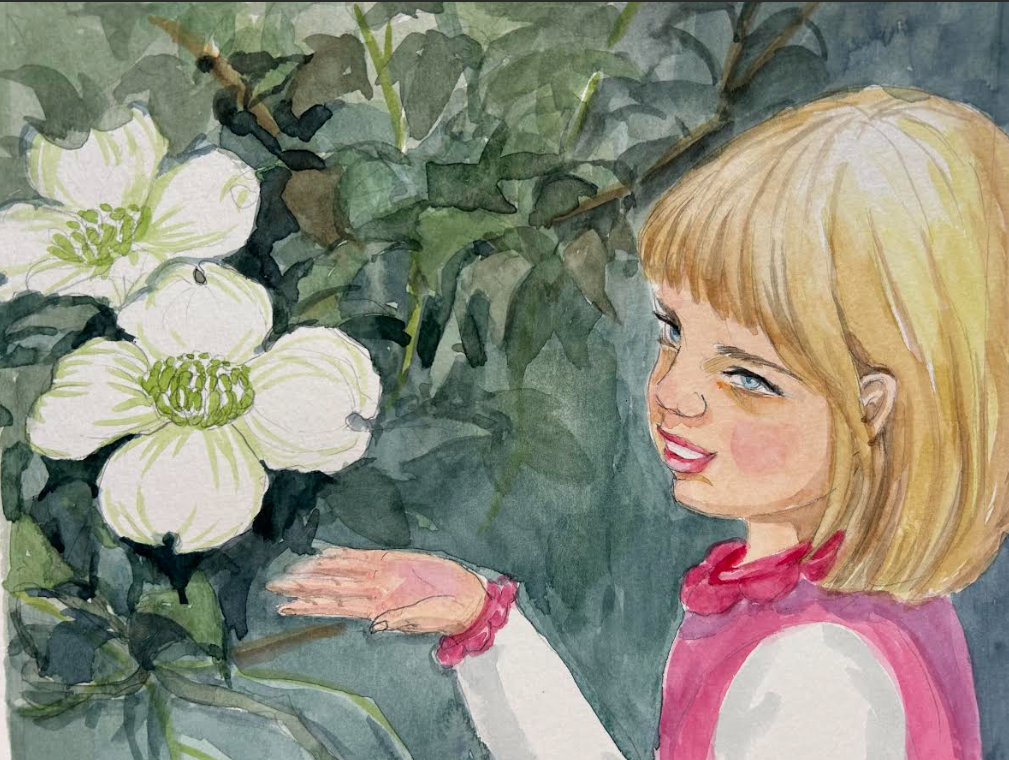
©Blue Swallow Farm Foundation, art work by Youngmi Organ
What is Play-Based Learning?
Play-based learning is an instructional approach that is prevalent in early childhood education and lower elementary settings (Dean & Wenner, 2025). A notable characteristic of play-based learning is that it is a child-centered approach where the teacher serves as a guide. An example of play-based learning would be that of children discovering force and motion with a variety of materials available for manipulation (e.g., trucks, ramps, rolling objects). In this case, children construct their own knowledge through discovery, creative imagination, and experimentation.
There are many interpretations of play-based learning, with an emphasis on socialization, language development, exploration, and imaginary play (Smedsrud et al., 2024). The role of the teacher varies depending on the instructional goals. During free play (unstructured approach), children use their creativity and imagination to explore the world around them and learn important skills like problem solving. In contrast, guided play (structured approach) follows a strategic plan to guide children through the learning process while still providing student autonomy in constructing their own knowledge (Caven, 2022). As outlined in the Early Childhood Program Standard 4 by the National Association for the Education of Young Children (NAEYC, 2025), “Educators should balance both child-led and teacher-scaffolded opportunities for play, exploration, and learning” (p. 5).
What are the Benefits of Play-based Learning in Natural Settings?
In general, there are many benefits to embedding play-based learning in early childhood education programs. Play-based activities are particularly relevant to children’s physical, social, and emotional wellbeing (Lee et al., 2020). The field of research is growing with evidence that learning in the outdoors increases student performance in mathematics and attentiveness as well as science (Mason et al., 2022; Khan et al., 2020). According to Dean (2025), play-based learning in outdoor settings fosters (a) academic growth in literacy, mathematics, science, and reading; (b) social emotional development by building confidence, cooperation, and communication skills; (c) physical wellbeing by improving motor development, coordination, movement skills, and risk-taking; and (d) provides a sense of place while connecting children to nature and encouraging environmental stewardship.
Natural settings afford some particularly useful learning experiences for developing problem-solving skills. For instance, learning outdoors inherently introduces unpredictable events that require children to be flexible, create solutions for shifts in their environment, and often require increased physical movement (Bjørgen, 2016). For instance, a child exploring with a stomp rocket outdoors who is trying to hit a goal, will have to account for changes in wind patterns. Or a child exploring a pond will react quickly when they spot a frog.
Developing Scientific Observation Skills through Play-based Learning
In general, play-based learning should provide ample opportunities for children to explore, discover, and experiment while using their creativity and imagination. These activities can be part of free play or guided play. One way to support student learning is to guide students in noticing, an important aspect of scientific observation skills (Eberbach & Crawley, 2009; Hiller & Kitsantas, 2015). Young children benefit from noticing events. Particular activities that correspond with noticing are counting, classifying, collecting, and measuring. Below are some practical examples of play-based learning that can be facilitated in outdoor classrooms.
- Collecting natural specimens to hang from trees to create tree art
- Launching hand-held confetti streams to notice motion in the wind
- Collecting seashells and sorting them by size, shape, and color
- Counting the number of leaves collected outside and classifying them based on the number of points in the leaves
- Measuring water in a cup and counting how many cups are needed to fill different sized containers
- With teacher support, observe macroinvertebrates from a stream and describe the difference and similarities between the organisms
- Creating a clay earthworm based on observing these creatures-then placing the earthworms on trees to see if birds leave pecking markings
Conclusion
Play-based learning is a critical component of a child’s development. Integrating outdoor experiences with play-based learning is a complimentary way of fostering children’s academic, social, and physical wellbeing. With creative planning, there are countless ways to engage children with the natural world.
Share
LATEST RESOURCES

Apples: Play-based and Guided Play Experiences in Pre-K
© Blue Swallow Farm Foundation, artwork by Youngmi Organ
© […]

Construction of an Outdoor Learning/Flex Space
Construction of an Outdoor Learning/Flex Space
Scott Fortney
Loudoun County Public Schools […]

Engaging Digital Natives Through Literacy, Outdoor Learning, and Technology
Engaging Digital Natives Through Literacy, Outdoor Learning, and Technology
Erik […]